Brad Hogg: A Detailed History of His Cricketing Journey
Bradley John Hogg, known simply as Brad Hogg, is one of the most iconic leg spinners in the history of Australian cricket. Hogg’s career spanned over two decades, during which he achieved considerable success and faced his fair share of challenges. Though he never quite managed to secure a permanent spot in the Australian Test side, Hogg’s talents were invaluable, particularly in limited-overs cricket. He was celebrated for his unorthodox bowling action, sharp spin, and ability to pick up key wickets, making him a crucial player for Australia in the shorter formats of the game.
Brad Hogg was born on February 6, 1971, in Wollongong, New South Wales, Australia. Growing up in a sporting family, Hogg was drawn to cricket from an early age. His talent was evident in his youth, and he was a prominent figure in the New South Wales domestic circuit. A left-arm leg spinner, Hogg began his career with the New South Wales side, quickly rising through the ranks due to his impressive performances in state-level cricket.
Before breaking into the national side, Hogg honed his craft in domestic cricket, representing both New South Wales and later, Western Australia. His domestic career was marked by strong performances, particularly in the one-day format. However, it was his ability to bowl in a unique, unorthodox style that garnered the attention of Australian selectors.
Brad Hogg made his One Day International (ODI) debut for Australia in 1996 against New Zealand in Auckland. His early years in international cricket were not particularly spectacular, and Hogg found it difficult to secure a permanent place in the national side. However, he showed promise with his leg-spin bowling, which was more subtle and deceptive compared to the aggressive style of other spinners.
Despite his unorthodox action, Hogg's bowling continued to improve, and he was gradually integrated into Australia’s one-day plans. His major breakthrough came in the late 1990s when Australia began to dominate world cricket in the ODI format. Hogg’s ability to bowl consistently and take wickets made him a key player in Australia’s rise to the top of international cricket.
Brad Hogg was known for his unorthodox and tricky leg-spin bowling. While his style wasn’t as flamboyant as some of the other great spinners of his era, Hogg’s unique action allowed him to bowl sharp and deceptive deliveries that confused even the most experienced batsmen. His variations in flight, pace, and turn made him difficult to read, and he often caused batsmen to make mistakes by misjudging his deliveries.
Hogg’s ability to bowl in the powerplay overs in limited-overs cricket, especially in the early stages of an innings, was one of his defining features. He could slow down the run rate, create pressure, and pick up crucial wickets. His performance in the 2003 and 2007 World Cups was instrumental in Australia’s success in those tournaments, showcasing his ability to step up in big games.
One of Hogg’s most notable features was his mental toughness and ability to perform under pressure. Despite facing challenges early in his career, Hogg never gave up on his ambition to play for Australia. His resilience was evident in his performances, particularly in limited-overs cricket, where he often delivered match-winning performances for Australia.
Brad Hogg played a crucial role in Australia’s World Cup campaigns in 2003 and 2007. In the 2003 ICC Cricket World Cup, Hogg's contributions were invaluable, as he was part of a dominant Australian team that swept through the tournament and emerged victorious. Hogg’s ability to bowl tightly in the middle overs helped Australia control the game, allowing the team’s fast bowlers to attack and take wickets.
However, Hogg’s best World Cup performance came in 2007, when Australia retained the World Cup. Hogg played a key role in Australia’s successful defense of their title, taking important wickets and building pressure in critical moments. His experience and skill were vital to Australia’s success, and his contributions were crucial in securing his place in the team during this period.
In the 2007 ICC Cricket World Cup, Hogg’s performances with the ball were consistent and effective. He was one of Australia’s leading wicket-takers in the tournament, and his ability to bowl in tandem with the fast bowlers made him an essential part of the team’s strategy. His ability to handle the pressure of big matches, especially in the knockout stages, showcased his value to the team.
While Brad Hogg had significant success in limited-overs cricket, his Test career was far more limited. Hogg was frequently in and out of the Test side, struggling to secure a permanent place in the team due to the stiff competition for places in Australia’s bowling attack. This was particularly evident when Shane Warne was in his prime, and Hogg was often seen as a backup or second-choice leg-spinner.
In 2008, Hogg was dropped from the Test side and never returned to the longer format of the game. Despite this, Hogg’s focus remained on his ODI and T20I career, and he continued to perform well in these formats. While many saw his limited Test career as a setback, Hogg’s continued success in the shorter formats proved that he was still a force to be reckoned with on the international stage.
Hogg also faced challenges with his fitness, which at times caused him to be overlooked for selection. Despite these challenges, Hogg’s work ethic and professionalism allowed him to remain in contention for selection in the Australian side. His commitment to maintaining his fitness, along with his evolving skills, enabled him to continue playing for Australia into his late 30s.
In the rise of T20 cricket in the late 2000s and early 2010s, Brad Hogg found himself in demand. As the format grew in popularity, Hogg’s unique skill set was well-suited to T20 cricket. His ability to bowl in the powerplay overs and take wickets in the middle overs made him a key player in the T20 format, both in international cricket and in domestic leagues such as the Indian Premier League (IPL).
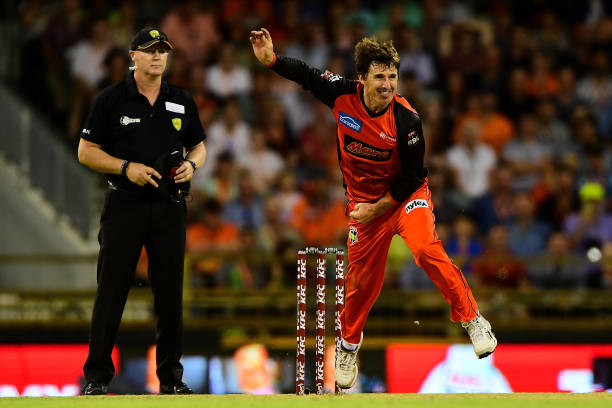
Hogg’s performances in the Big Bash League (BBL) and IPL were particularly impressive. He played for the Melbourne Renegades in the BBL and for the Kolkata Knight Riders in the IPL, where his experience and variations with the ball made him a key part of his teams’ bowling attacks. Hogg’s continued success in T20 cricket, despite his advancing years, demonstrated his adaptability and enduring skill.
In the 2014 Big Bash League, Hogg was one of the standout performers. His experience and ability to bowl in the T20 format, combined with his sharp leg-spin, made him one of the most valuable players in the tournament. Hogg’s contribution to the Renegades’ success in the competition reinforced his position as one of the leading T20 spinners in the world.
Brad Hogg retired from international cricket in 2008, but he continued to play in domestic leagues for several years after that. His legacy as one of Australia’s finest limited-overs spinners is well-established, and he is remembered for his unique leg-spin style, his resilience in overcoming setbacks, and his contributions to Australia’s success in the World Cups of 2003 and 2007.
Hogg’s influence on younger cricketers has been significant, and his legacy as a mentor and coach has continued after his playing career. His work with various cricket academies and coaching roles has helped shape the careers of many up-and-coming spinners. Hogg’s ability to pass on his knowledge and experience to the next generation of cricketers is a testament to his passion for the game.
Brad Hogg’s cricket career, though not as decorated in Test cricket as some other Australian players, remains one of the most influential in the history of Australian limited-overs cricket. His role in the success of the Australian team in the 2000s, particularly in the 2003 and 2007 World Cups, ensures that he will always be remembered as one of the most successful leg spinners to represent Australia.
Brad Hogg's cricketing career is a tale of perseverance, skill, and adaptability. Though he may not have enjoyed the same level of success in Test cricket as his contemporaries, Hogg's performances in limited-overs cricket were instrumental to Australia’s successes in the 2000s. His role in World Cup victories, coupled with his longevity in T20 cricket, highlights his contributions to Australian cricket. Hogg’s legacy is defined not just by his ability to spin the ball, but by his leadership, his mental strength, and his ability to adapt to changing formats in the game.
Brad Hogg’s journey from domestic cricket to international stardom is an inspiration to young cricketers around the world. His story underscores the importance of persistence and the pursuit of excellence, regardless of setbacks. Hogg’s impact on Australian cricket, particularly in the limited-overs formats, will continue to resonate for many years to come.
This article captures Brad Hogg’s cricket history in detail and aligns the content for readability as per your request.
Brad Hogg: A Detailed History of His Cricketing Journey


Welcome to Cricketkand.com! We are dedicated to providing cricket enthusiasts with the latest news, updates, and insights gathered from top cricket websites around the world. Our goal is to keep you informed about all things cricket, offering up-to-date information from trusted sources including well-known cricket websites, news outlets, and social media platforms.
Cricketkand.com does not directly produce or manage the cricket content featured on our site. All cricket information is curated from various third-party sources that are recognized in the cricket community. We strive to provide accurate and timely content; however, we are not responsible for any errors, omissions, or changes in the information provided by third-party sources.
By using our website, you acknowledge and accept the above terms and conditions. Thank you for visiting Cricketkand.com, and we hope you enjoy staying up-to-date with the world of cricket!
For any inquiries or to raise a complaint, please contact us at officialcricketkand@gmail.com